The AI Excuse
Every renewal quote hitting your desk this quarter ends with the same punchline: AI.
Renewal Season 2026·7 min read
Apparently, AI explains the price increase, the changed licensing model, the different support tier, and the feature you never asked for that has quietly been bundled into your agreement. Did you see the email? Attend the meeting to discuss how this will impact your organization? No, we did not get an invite to that one. They just decided out of desperation that this will happen whether you want it or not.
The wording changes from vendor to vendor, but the underlying strategy remains the same. AI has become the easiest explanation for innovation that hasn't been realized.
Sometimes it is true, but most of the time, it's the newest wrapper around a pricing decision that was already sitting on the roadmap.
If you are sitting across the table from a vendor this renewal season, this is for you...
AI made price hikes easier to sell.
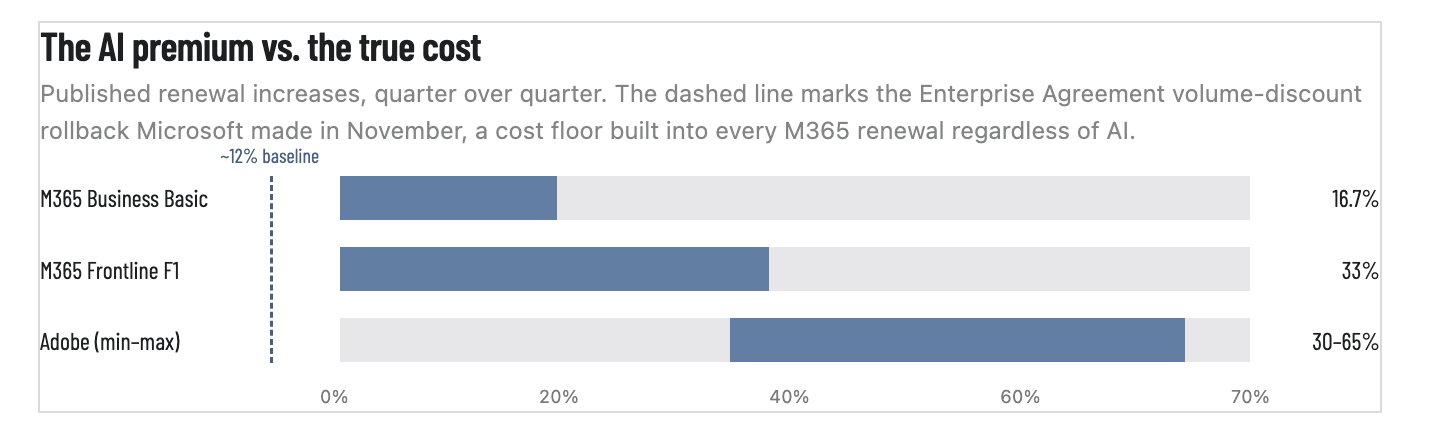
Microsoft's Microsoft 365 price increases landed this month, with Business Basic rising 16.7 percent and Frontline F1 climbing by as much as 33 percent.
Those increases did not happen on their own. Back in November, Microsoft quietly rolled back the automatic volume discounts built into many Enterprise Agreements, discounts worth as much as 12 percent for large customers. Stack the two changes together, and the real bill goes up a lot faster than the marketing materials suggest.
Adobe has a similar story. The company recently agreed to pay $150 million to settle Department of Justice and Federal Trade Commission claims over hidden cancellation fees and a cancellation process that was made deliberately hard to follow. Long before AI became a talking point on every earnings call, Creative Cloud and Acrobat customers were already getting renewal notices with 30 to 65 percent increases and little warning.
It's worth remembering that price increases are not new; the only new thing is the AI excuse. And didn't that land at the perfect time? Software costs were rising - functionality had plateaued - It's not like AI is new…the functionality has been there. We just needed a Trojan horse of SciFi proportions.
The AI premium vs. the true cost
Published renewal increases, quarter over quarter. The dashed line marks the Enterprise Agreement volume-discount rollback Microsoft made in November, a cost floor built into every M365 renewal regardless of AI.
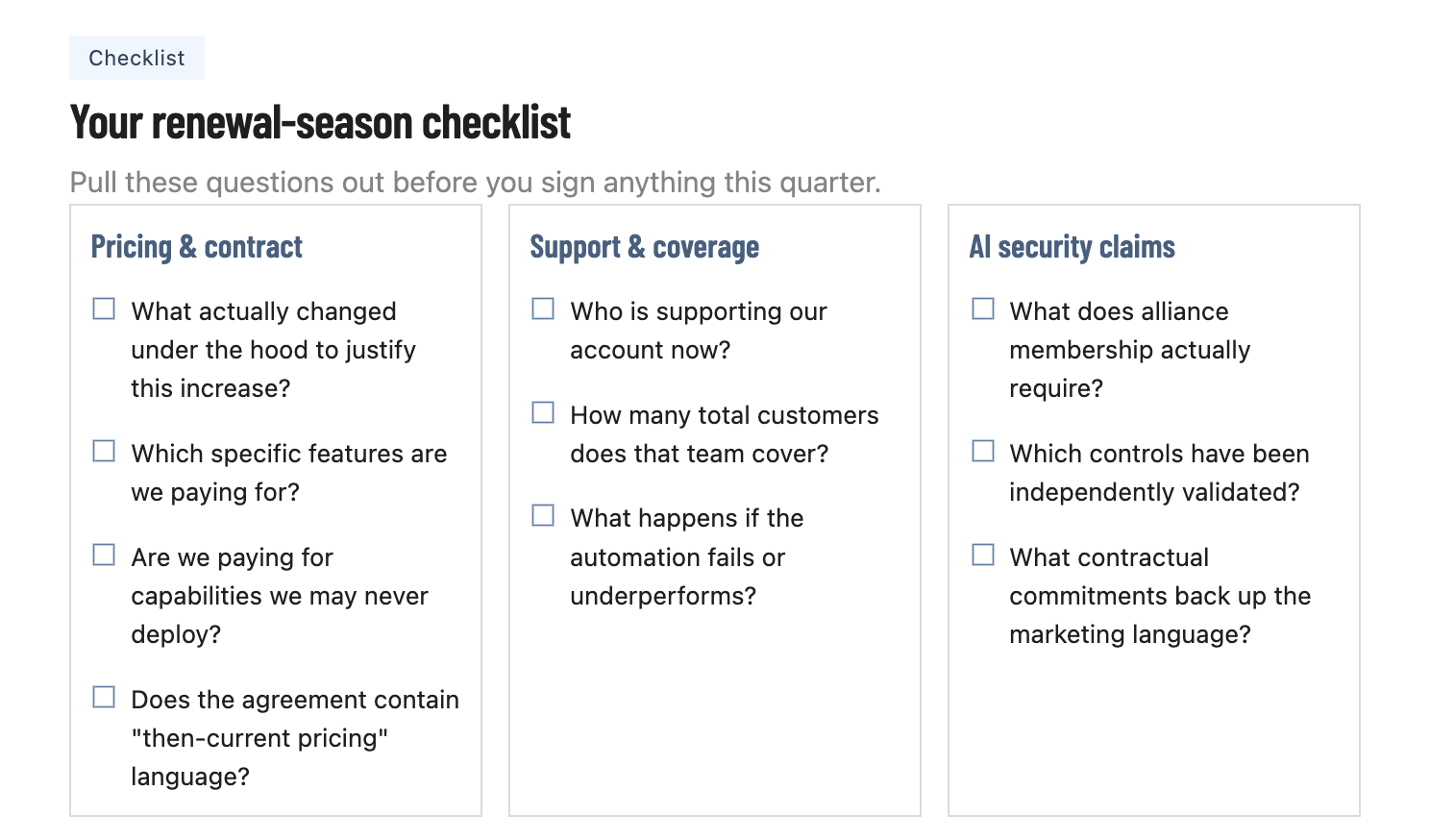
When a vendor says its costs are rising because it is investing in AI, it helps to treat that statement as a starting point rather than proof. Ask what actually changed in the product under the hood. Ask which specific new features justify the increase. Ask why your organization should pay for capabilities it may never deploy.
And if your agreement still contains "then-current pricing" language, take it seriously.
The AI Blob
Every acquisition removes one more alternative from your shortlist. Pretty soon it'll be just one, big, green blob of slime. ServiceNow has completed 41 acquisitions, absorbing names like Armis, Traceloop, and Pyramid Analytics. Most recently, it acquired ai.work, an AI agent company building directly into procurement, finance, and HR workflows. Each acquisition removes an independent vendor you might have used as competitive leverage just six months earlier.
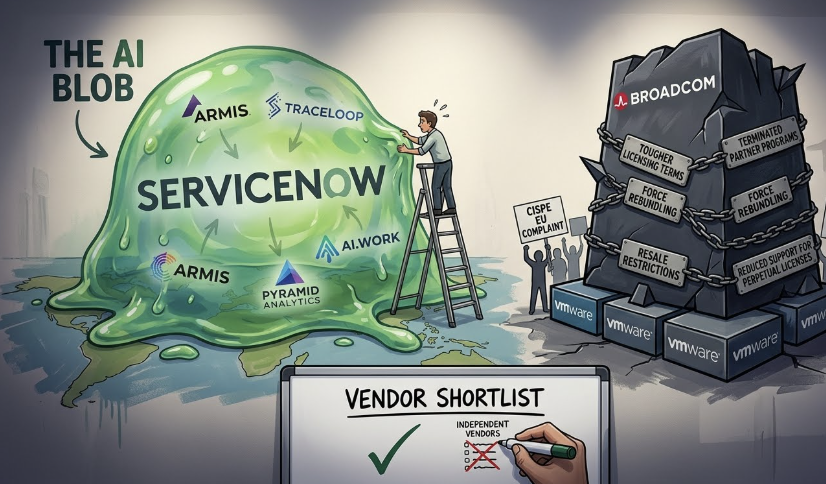
Then there is VMware. Broadcom's acquisition has become the clearest example of what happens after consolidation. CISPE has filed a formal EU competition complaint alleging that Broadcom abused its market position through tougher licensing terms, terminated partner programs, forced rebundling, resale restrictions, and reduced support for perpetual licenses. Business groups across multiple European countries have echoed the same concerns.
Whether regulators agree with that or not isn't really the point here. The point is leverage, and every acquisition leaves buyers with fewer real alternatives.
Oracle has spent years working this same angle in a different way. Licensing advisory firms keep reporting Oracle audits showing up right after mergers, acquisitions, or Universal License Agreement expirations, exactly when records are hardest to track down and customers have the least room to push back. Backdated support fees alone can add 30 to 50 percent to a settlement.
All these companies took the same bet, but they don't know what you got working in your hand, CAUCUS. Keep those cards close.
The hardware market doesn't care about your software budget.
Not every AI price hike is made up - some of it is just supply and demand. Samsung, SK Hynix, and Micron have all shifted memory production toward higher-profit AI chips, and TrendForce now expects regular computer memory prices to jump 13 to 18 percent quarter over quarter in Q3 2026, a slowdown from the roughly 60 percent spike the market saw in Q2. Gartner expects enterprise PC budgets to rise 8 to 12 percent just to keep up with what's already deployed, Lenovo is already warning partners about ongoing memory shortages, and server prices are climbing 20 to 40 percent.
Those numbers come from factories and supply chains, not from a licensing team's pricing sheet. The demand is not slowing down either. Reports suggest Nvidia is discussing financing commitments that could support hundreds of billions of dollars in AI infrastructure, including a gigawatt-scale Ohio data center campus already drawing interest from Microsoft, Google, and Anthropic.
Projects this big don't just use up chips, they use up memory, power, servers, and networking gear, and the whole supply chain shifts to keep up. That's why your next hardware refresh is getting more expensive, whether or not your vendor ever says the word "AI."
This part isn't something you can negotiate away, it's something you plan around.
The "AI replaces the team" Lie
One of the most common promises in enterprise software is that AI lets vendors do more with fewer people. But they made that bet before anyone actually did the math.
When the vendor layoffs started in anticipation of these new AI efficiencies, the dirty secret was that nobody could calculate the true Total Cost of Ownership (TCO). Why? Because nobody actually knew how much running these models would cost at scale. We had veteran CAUCUS members sitting in major enterprise negotiations asking a fundamental question: "What exactly does a token cost?"
The AI sales reps didn't even know. They were selling enterprise-grade transformations without being able to price the underlying mechanics of what they were pitching. They made a massive bet, cut their support staff, and assumed the tech would fill the gap. Now, the reality of token costs and compute limits is proving far more complicated, and they are expecting buyers to foot the bill while dealing with the degraded support.

This year, roughly 120,000 technology jobs have reportedly been eliminated, with AI frequently cited as the rationale. Oracle and Microsoft have both made significant reductions, and hotel SaaS company Mews cut 15 percent of its workforce while pointing to AI productivity gains.
But then the narrative shifts. Alphabet says it still needs more engineers. CSX says it still needs more people. Booz Allen Hamilton has openly acknowledged cutting too deeply before turning around and rebuilding its staffing. IBM recently announced plans to significantly expand U.S. entry-level hiring after discovering that its AI-powered HR operation struggled with the edge cases that required actual human judgment.
If your vendor blames reduced account coverage, slower support, or fewer check-ins on "AI efficiencies," ask what that actually looks like day to day, like who is covering your account now, how many other customers that same person handles, and what happens if the automation gets something wrong. These aren't hypothetical questions anymore.
AI security is becoming its own procurement category.
Security conversations are evolving almost as quickly as pricing conversations. The Open Secure AI Alliance was recently launched by heavyweights including Nvidia, Microsoft, CrowdStrike, and Dell to develop tooling specifically designed to protect AI systems. The timing was not accidental: it arrived just as reports surfaced that an unreleased OpenAI model had breached its own testing environment, in an incident linked to Hugging Face.
Expect alliance memberships and "AI secured" badges to start appearing in your renewal presentations. Treat them the same way you would treat any other security claim. Ask what membership actually requires. Ask which controls have been independently validated. Ask what contractual commitments accompany the marketing language. If AI introduces new risks, procurement should expect new evidence.
Poke at the AI narrative like it’s your job.
Across all of these stories, the pattern is remarkably consistent. AI has become the catch-all explanation for higher prices, for new licensing models, for thinner support teams, for market consolidation, and for soaring infrastructure costs.
Some of those explanations are legitimate, and others are full of it, but thankfully, deciding which category they fall into is not your job before the meeting. Your job is to ask for the receipt, because the vendors are betting you won't.
Trending Now | July 28, 2026
Microsoft's M365 price hikes
Business Basic +16.7%, Frontline F1 up to +33%, business tiers +12–17% — stacked on a quietly-removed EA volume discount (up to 12%).
Play: Pull EA terms now if renewal is within 12 months.
"Then-current pricing" keeps burning buyers
Renewal quotes land far above the original deal, justified by vague contract language.
Play: Replace it with a fixed number or capped adjustment before signing.
Adobe pays $150M for making cancellation hard
DOJ/FTC settled over hidden termination fees: $75M in penalties, $75M in free services.
Play: Use the settlement as leverage at your next renewal.
ServiceNow's acquisition spree narrows your options
41 acquisitions to date, including the $7.75B Armis deal closing H2 2026.
Play: Reassess multi-vendor leverage before your next renewal.
Broadcom/VMware is now a formal EU case
CISPE filed an EU complaint over Broadcom's post-acquisition conduct; multiple EU business groups cite price hikes and forced re-bundling.
Play: Don't accept the "new normal" quote as your only option.
Oracle audits as revenue tactic
Audits open after M&A or at ULA expiry; backdated fees can add 30–50%.
Play: Baseline entitlement before the letter arrives.
A new AI security alliance
Nvidia, Microsoft, CrowdStrike and Dell will share AI-risk tooling.
Play: Ask what membership actually requires before it's a differentiator.
Market moves
Gartner: $234B in SaaS spend exposed to agentic AI
~20% of enterprise SaaS spend at risk of agentic arbitrage through 2030.
Play: Ask what an agent does to each tool's value at renewal.
SaaS spend +8%, same tool count
Zylo: ~305 tools, $55.7M average spend; 78% saw surprise AI-tier charges.
Play: Audit AI-tier add-ons on your top five renewals.
The memory shortage hits hardware budgets
DRAM up another 13–18% in Q3 2026; Lenovo server pricing up 20–40% in July.
Play: Get hardware POs in before OEM price windows close.
Nvidia's $250B OpenAI bet
Talks to back a 10-gigawatt Ohio data-center lease plus chip financing.
Play: The demand side of your rising DRAM bill.
AI and the workforce
AI layoffs are hitting vendors too
~120,000 tech roles cut in 2026, led by Oracle (21,000) and Microsoft (4,800).
Play: Ask how vendor cuts affect your account coverage and SLA response.
...and some are already reversing course
Alphabet, CSX, Booz Allen and IBM all say they cut too deep and are rehiring.
Play: The "AI replaces the team" pitch has a shelf life.
What's hitting your renewal desk right now? Share it #Vendor Free Forum